
There is only one person who is responsible for your happiness!

Photo Credit: Free Digital Photo’s
There is only one person who is responsible for your happiness!
Photo Credit: Free Digital Photo’s
Filed under Caregiving
 Robert B. Hudson says that some members of the health care community “have treated LGBT people with condescension, and that in turn has often led people to put off preventive services.” Photo courtesy of the Boston University School of Social Work
In 2009, according to the U.S. Administration on Aging, about one in eight Americans was over age 65. That adds up to 39.6 million people, or almost 13 percent of the U.S population. By 2030, there will be about 72.1 million in that age group, or about 19 percent of the population.
While many studies have been done on America’s aging population, little research has focused on a group facing special issues as they age: the lesbian, gay, bisexual, and transgender (LGBT) community. Today’s LGBT elders have lived through decades of discrimination, which, it turns out, has huge repercussions as they age. Yet LGBT seniors have been largely ignored in policy on aging.
To help address this oversight, Robert B. Hudson, a School of Social Work professor of social policy and managing editor of the journal Public Policy and Aging Report, devoted an issue to the topic of LGBT seniors, with articles written by a range of researchers, service providers, and advocates involved with LGBT policy concerns. According to Hudson, the issue received more positive feedback “than just about anything else we’ve done.” In his introduction, he writes, “These individuals have remained nearly invisible to the community of advocates, researchers, practitioners, administrators, and politicians who associate themselves with the modern aging enterprise.”
BU Today recently spoke with Hudson about the insights gained from the project and what steps need to be taken to help aging members of the LGBT community.

Hudson: One thing we’re always trying to do is highlight under recognized issues, and this is one that really has to be near the top of the list. There is simply not much of a literature devoted to older LGBT people. There is a whole world of aging research and aging agencies that provide a range of benefits to older people, and there is a separate series of agencies and research that address the LGBT population. But they often don’t come together.
Well, as a political scientist, I see it centrally rooted in bureaucratic behavior. The aging agencies are organized around classic aging-related issues like nutrition, social services, and legal services. The LGBT community has never had the same level of attention.
Massive under service. When you look at the literature, LGBT access to health care is suboptimal. And that’s for two reasons: one is that some members of the health care community have treated LGBT people with condescension, and that in turn has often led people to put off preventive services. More broadly, LGBT individuals are often denied protections such as survivorship, visitation rights, and living wills, because the legal system does not recognize their living arrangements.
The mental health issues are the ones that stand out, and I think it’s something that the larger population does not appreciate. The stressors around discrimination in those communities have been so high for so long that substance abuse issues are much more widespread than the larger public thinks. People ought to know that discrimination has consequences.
The other issue to be mentioned is HIV-AIDS. And again, something that is underrecognized is that people who are HIV-positive are getting older, thanks to drugs that are turning HIV-AIDS into a chronic illness rather than a death sentence. But it is also true that people are contracting AIDS over age 55 at somewhat higher rates than before.
Indoctrinated, yes, but on the other hand, I think it’s something about aging. I think some people may say, “We’re old, we probably can’t get it.” But in fact, as you get older, the body becomes more fragile, and it may make transmission more likely.
I think that has been the case. A lot of the public health initiatives within the LGBT community are aimed implicitly—if not explicitly—at younger people. The classic imagery we’ve had of older people in general is relevant here; they’re frail and alone or cut off in nursing homes, so they tend to get forgotten and excluded from all sorts of helpful interventions. And then members of the aging community, either through lack of interest—or in some cases, discrimination—may not want to engage with the older gay population. And so older LGBT folks really do fall between the cracks.
Well, for somebody my age it’s not hard to remember. I mean, you could get in all sorts of serious trouble by identifying as gay or being seen as gay—bullying, violence, employment discrimination, health care, the whole gamut. I think most people now don’t recognize how tough it was for LGBT people to grow up in the world they did. And if you listen to today’s political debate, there are candidates out there who are inferring things about certain populations—including this one—that are pretty nasty.
Certainly there are impacts in mental health issues, but also in economic issues. If you were discriminated against at age 20, 30, and 40, trying to get a decent job, trying to get promoted, trying not to get fired, hoping to be invited to the company family picnic, needing to go out on the golf course with the guys where the deals are being made, and they shun you because they suspect you’re not one of them—there are huge career ramifications.
So it really is a lifelong thing. In aging we talk about “cumulative advantage” and “cumulative disadvantage.” If you went to Andover and Harvard when you were younger, you have a better train ride than somebody who didn’t. And in this case, to have been knocked off career and health care and other rails early on by reason of discrimination, a trajectory that might have gone quite high will instead be flat. And in some ways it gets worse in old age. The passage of time amplifies the discriminations you’ve encountered over the course of 30 to 40 years.
It’s a huge issue. In the case of chronic illness, something like 80 percent of all care is provided by so-called informal supports—mainly family, notably wives, daughters, and daughters-in-law. This is a population that has much lower marriage rates and somewhat higher levels of disaffection from their biological families due to their orientation. There are fewer children, fewer spouses, and the extended family of aunts, uncles, nieces, and nephews may also be thinner. That is compensated for in part by friends, but the lack of family-based informal supports is a concern in this community.
I think over time, with greater acceptance of these communities, yes it will get better. But it’s going to be a long process. It’s interesting the extent to which same-sex marriage has taken hold in many parts of the country, which certainly wasn’t the case 20 years ago. But it’s going to be a very long process.
I think that’s right, but I think it will vary a lot geographically. There are still a number of states where gays and lesbians cannot adopt children.
Interesting question. There are retirement communities—I don’t know their legal status—that certainly have attracted LGBT people. There are at least two or three dozen retirement areas in various parts of the country that are known to be attractive to members of the LGBT community. It wouldn’t be possible in most nursing homes because it would violate Medicaid reimbursement laws.
On the policy level, I always think first of Social Security benefits. If you don’t have legally recognized dependents, you can’t get a dependent benefit. If you die and you had a partner, but you were not legally married—and to the federal government you can’t be legally married if you’re gay or lesbian—then there’s no survivor benefit.
In the health care world, prohibitions tied to visitation and to proxies and living wills are big things that have to be overcome.
But I think the biggest issue is in some ways the hardest issue to tackle, and that is acculturation and acceptance: being fully accepted as part of the range of American citizenry. LGBT elders may not be exactly like you, but there are lots of people who aren’t exactly like you, so let’s get over it, old and young alike.
View a copy of the Public Policy & Aging Report issue “Integrating Lesbian, Gay, Bisexual and Transgender Older Adults into Aging Policy and Practice” here.
Barbara Moran (COM’96) is a science writer in Brookline, Mass. She can be reached through her website. Permission to post this article on ‘The Purple Jacket’ was granted by Barbara Moran.
Filed under Caregiving
One of the major routes to social change is through audacious theorizing. – Kenneth Gergen

Photo Credit: Free Digital Photos
Filed under Caregiving
Life is meant to be lived in forward, not in reverse.

Photo Credit ‘Free Digital Photo’s’
Filed under Caregiving

I have to admit, I have had a difficult time writing these past few weeks. “The Little One” continues to excel now that we are settled in South Florida. While there has been a couple of flare ups recently with his esophagus, all in all, his progress continues to exceed expectations. We are most thankful.
While reconnecting with a good friend of mine here in South Florida, we started a conversation in regards to Caregiving. As a PHD and LCSW, my friend is a trusted advisor who just happens to be straight, but not narrow! 🙂
One morning over breakfast he asked me…”What exactly is different about LGBT Caregiving.” A very profound question that is easy to answer, yet difficult to explain. “Caregiving in an of itself is the same for every couple, you simply care for the one you love. The difference for the LGBT caregiver is when we have to interact with systems outside of our home that are out of our control .”
I continued on with an example so that my friend could better understand my position. (Speaking to my friend now) Consider both of us arriving at the hospital emergency room as caregivers: you are attending to your wife, me attending to my partner. The farthest thing on your mind on the way to the hospital is how will you, as the husband, will be accepted by the hospital staff.

Photo Credit: Free Digital Photos
On the other hand, when we walk into the hospital there is always the aspect of doubt lurking behind those doors …’What is the nature of your relationship,’ is a commonly asked question when two individuals of the same sex appear on the scene. You walk in with your wife, the staff and attendants at the hospital presuppose that you are a married couple. We on the other hand are constantly in fear of losing access to the one that we care for and love. I doubt you travel with your marriage license or Power of Attorney on a regular basis in order to prove your relationship in these professional settings? I never leave the house without a copy of all our legal documents. Even with the legal documents, that does not guarantee acceptance as often times we will have to deal with an employee’s individual bias and bigotry.
It was at that moment that a ‘red light’ went on in with my friend. “I completely understand the issue about marriage equality now.” The conversation continued on as it relates to social security, benefits, the entire, housing, pension, etc. (I will be blogging about the marriage equality issue later this week) What this conversation demonstrated to me was that when you put a face to an issue, you have a better chance of understanding the issue at hand. This is exactly what happened with my friend. What was foggy, now was clear. All it took was a clear, everyday example to help turn the light bulb on. It was nice to teach a PHD a trick or two; but we have a long way to go with this important issue that faces our society and aging population today!
You See…We might have cancer, but cancer does not have us!
Filed under Caregiving
Please…’Know The Sphere’… You will enjoy it immensely!
Many men often come to a point in life where they are begged to learn or unlearn. This point is the precipice of a denouement of sorts; of a becoming or of a realization. When we come to this point, we either accept or deny the truth that we find. This is the sphere of crossroads.
When any human being is confronted and forced to review their personal dogma, many things happen. No man welcomes this review. Though some accept it, this review is often unwelcome as it is too personal an issue to be disregarded. This is especially true when regarding spiritual dogma. If the tenet of belief is challenged, one will find any phrase or quotation to prove his point. Most often this is done in denial, when a simple truth has been brought forward.
When confronted with a spiritual or dogmatic crossroads, a man first holds fast…
View original post 425 more words
Filed under Caregiving
Having a Sister is like having a best friend for life!
Filed under Caregiving

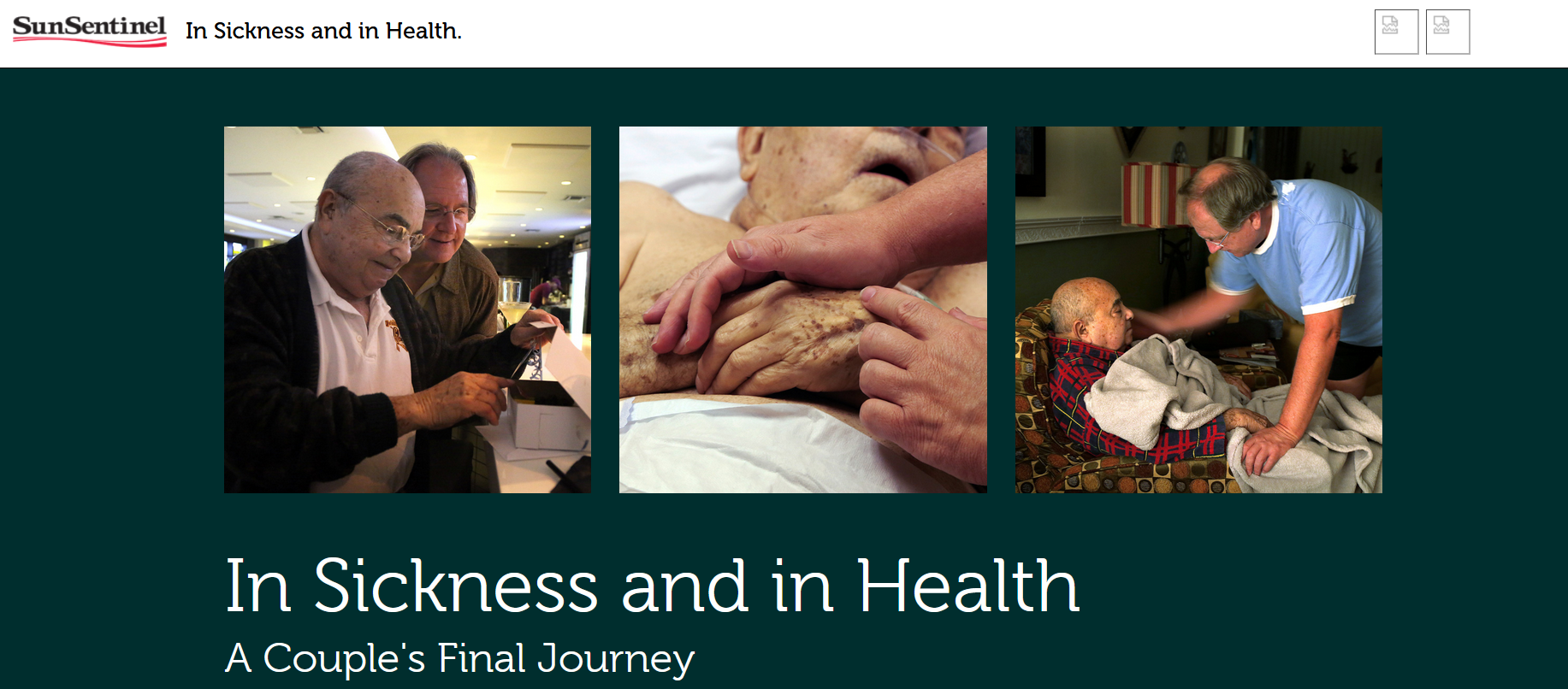


Nominated for a Pulitzer Prize in 2015, Our Caregiving Story "In Sickness and In Health: A Couple's Final Journey" written by Diane Lade and photgraphed by Carline Jean from The South Florida Sun-Sentinel. Click on the photo to be taken to the original story. Photo Credit Carline Jean/Sun-Sentinel

Story 2: "Life After Death: Couple's Story Sparks Change." Click on the photo to be taken to the second story. Photo Credit Carline Jean Sun-Sentinel

Story #3 "Saying Goodbye" Click on the photo to be taken to our final story. Photo Credit Carline Jean/Sun-Sentinel

Visit Our New Whole Care Network Website by clicking on the Whole Care Network icon!

"What's The Deal With Caregiving?" is available on Amazon. Click above to see the reviews of the book and to purchase a copy of your own


As a certified accessible travel advocate, I can book all your travel plans! Ask me how you can have anything from oxygen to a hoyer lift delivered to your cruise ship stateroom or hotel around the world! For more information email me at chris@tlocruisesandtours.com

Healing Ties radio is syndicated in the United Kingdom on UK Health.com! Click on the icon to follow the show in the UK




 The Purple Jacket