Having The Talk: How To Make End Of Life Wishes Easier


The best preparation for tomorrow is doing your best today. H. Jackson Brown, Jr.

Richard and I during one of our many talks about what he wanted. This conversation centered around his medication.

Having “The Talk” does not have to be hard or difficult, yet the talk does have to happen at some point in our lives.   I’m not referring to the birds and the bees talk our parents have with us when we are adolescents. “The Talk” I am referring to is the talk we have with our loved ones about end-of-life wishes.

As a caregiver, one of our most important roles, if not the most important one of them all, is to be an  advocate. How can one advocate if you do not know the wishes or desires of the person in your care?  Richard and I always had the ability to talk openly about his wishes. In fact, our end-of-life conversation happened spontaneously; by the end of the conversation, our tears of love and joy were comforted by the knowledge that I knew exactly what he wanted.  “I will tell you when I am ready for hospice” he bellowed…Yes you did!
the talk

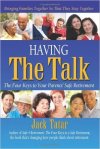
Click on the image to purchase Jack’s book

Recently I had the opportunity to visit with Jack Tatar who has written a book called “Having the Talk.”  “Having the Talk” focuses on ways to begin a family discussion earlier rather than later, about planning for the later life issues of a retired or retiring parent. Jack’s research demonstrated to him people have “the Talk”, but they have it too late, either when there’s little that can be changed, or after expectations have been set by siblings about “who gets what.” When this happens, families are torn apart, and loved ones who played together and protected each other throughout their entire lives now find themselves not talking to each other, usually all the way to their deathbeds.

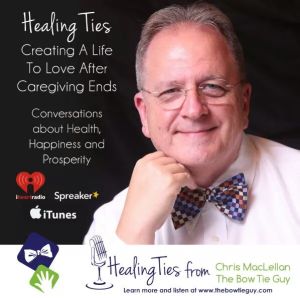
Here is our recent episode of “Healing Ties” featuring Jack Tatar as we discuss how to have those difficult end-of-life conversation.  

While I understand not everyone is going to be able to have the same experience of having “The Talk” like Richard and I did, let me share a few suggestions on how you might approach this delicate conversation:

  • Always use open-ended question
  • Don’t force the conversation, if there is strong resistance, back off and revisit it at another time
  • Express the importance of  the need for you to be comforted, knowing that by following their wishes, makes it easier on you
  • Enlist the help of an objective third-party
  • Use examples of family and friends.
  • Learn about The Five Wishes 

I believe there are two common aspects to caregiving that everyone experiences, there is a beginning and there is an end, and in most cases, we are not prepared for either one of these life changing events!  It is difficult to plan for the unexpected, but having a plan in place does help temper the confusion when an emergency happens.

Have the talk…you will be glad that you did!
 

wp-1448474801512.jpeg wpid-wp-1448113432219.jpeg

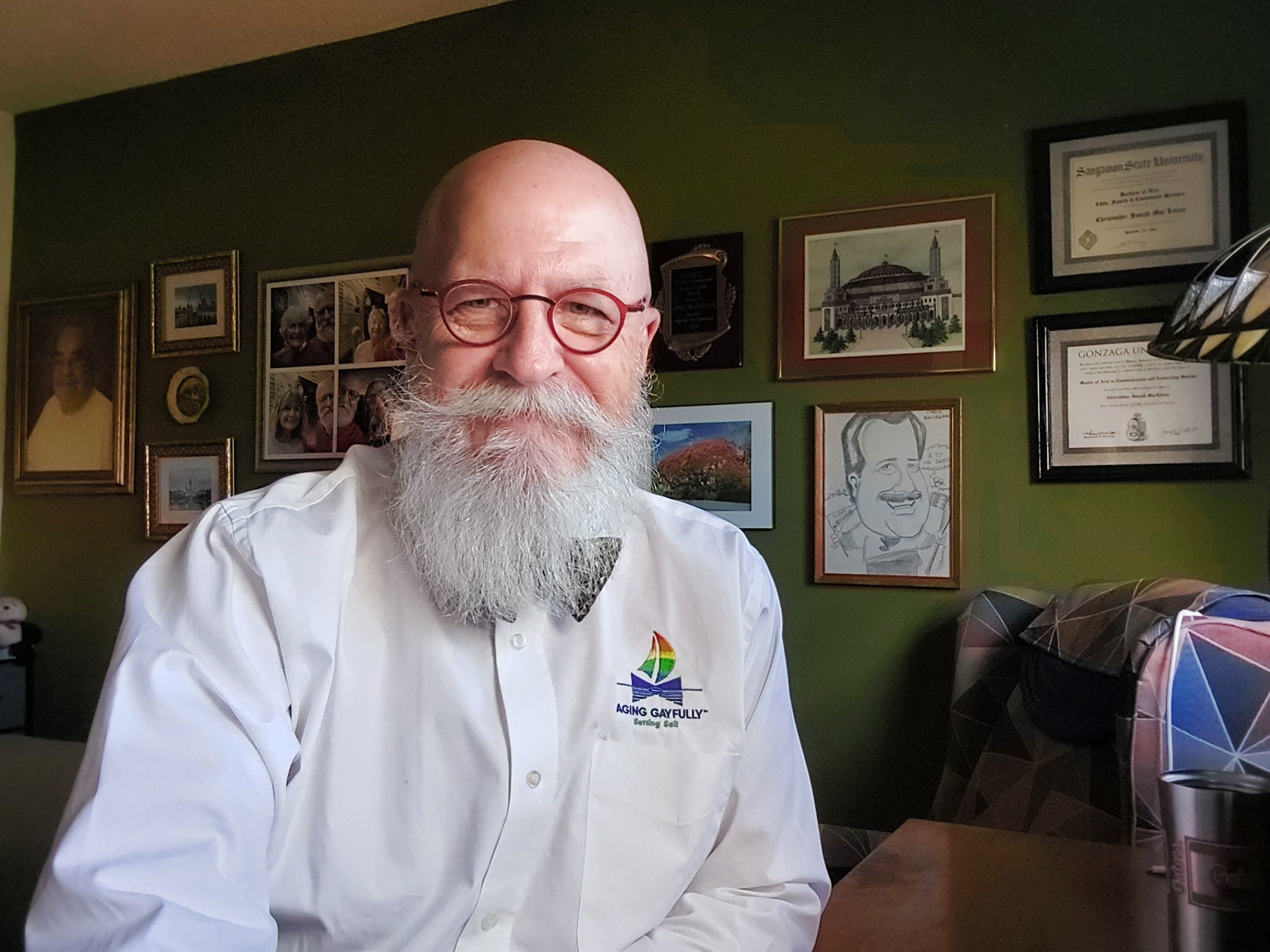
Christopher MacLellan, MA is a Certified Senior Advisor, Certified Caregiving Consultant, the author of “What’s The Deal with Caregiving?” and the host of “Healing Ties™” podcast.

All rights reserved ©WholeCareNetwork, Inc.

1 Comment

Filed under Caregiving, The Purple Jacket

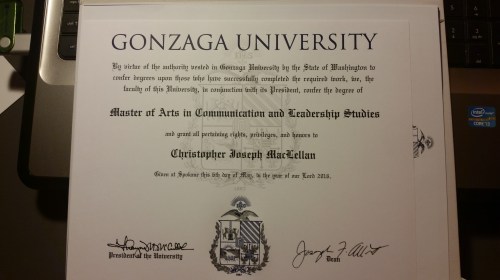
Diploma In Hand


My diploma arrived today…WOW!  I am dedicating my diploma to Bernard Richard Schiffer and all caregivers with my pledge to continue to advocate for caregivers and their caree’s for as long as I live.  This diploma is for you, TLO!

20160620_162758.jpgwp-1466473021951.jpgTLO

4 Comments

Filed under Caregiving, The Purple Jacket

Dec. 3 in Chicago: 1st Annual National Caregiving Conference


The Whole Care Network and The Bow Tie Guy is excited to be part of the 1st Annual National Caregiving Conference Dec. 3 in Chicago:

chicago-890354_640Organize a caravan for your support group members. Create a car pool with your co-workers. Plan a get-away for you and your caregiving friends.
And, then come to Chicago in early December to connect, share, support and learn at our 1st Annual National Caregiving Conference.

Our conference will take place on Saturday, December 3, at the Chicago Marriott O’Hare, conveniently located minutes from O’Hare and a subway ride from downtown Chicago. Feel free to spend the weekend at the hotel; we’ve got a special conference room rate of $119. Our conference begins at 9 a.m. on Saturday morning and wraps up at 5 p.m. You can spend Sunday shopping or sight-seeing.

The goal of our conference is to connect you with support and solutions; empower you with insights and information; and entertain you with engaging and enlightening presentations. We also want to spark important conversations about what we need as family caregivers and former family caregivers in our communities, our workplaces and our health care system.

You’ll want to attend our conference if:

  • You care for a family member or friend;
  • You cared for a family member or friend;
  • You work with (or want to work with) family members, either in your own business or in an organization or agency;
  • You offer products and services for family caregivers.

Our conference will include an exhibit floor and educational sessions featuring three separate tracts:

  • Family Caregivers: Connect with others who care for a family member; attend sessions which speak to your experiences and gather resources which help you manage the experience.
  • Former Family Caregivers: Connect with others adjusting to their life after caregiving ends and attend sessions which help you enter the next phase of your life.
  • Professionals Working With Family Caregivers: Connect with others who work with family caregivers, either through their own business or in an agency or organization. Gain insights into the caregiving experience which will help you work well with family caregivers. In addition, learn marketing techniques to help you reach family caregivers.

The tentative cost for family caregivers and former family caregivers to attend is $10. The cost for those who work with family caregivers is $50; we’ll also offer CEUs. Your cost includes breakfast and lunch as well as access to our sessions and exhibitor floor on Saturday. You’ll pay for your travel expenses, including your hotel.

I’m working to create respite options so your caree receives care while you take a break. I’ll keep you posted.

Look for a call for presentations on July 5. Presentation proposals will be due August 2 and we’ll notify you if we’ve chosen your presentation on August 23.

We’d love to get a feel for how many will attend our conference. Please let us know via the form, below, your interest. We’ll also send you regular updates, including information about sponsors, presentations, special activities and exhibitors.

Follow this link to the form to submit your information.

http://www.caregiving.com/2016/06/dec-3-in-chicago-1st-annual-national-caregiving-conference/

Leave a comment

Filed under Caregiving, The Purple Jacket

Webinar: Working and Caregiving Survey Results


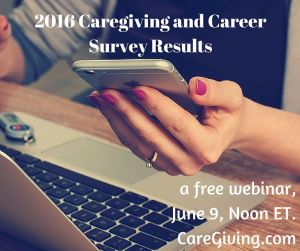
e6d06522-963a-4fad-8fa6-11992d1bee66I was most thankful to participate in Caregiving.com  annual Working Family Caregiver Survey earlier this year.  Your participation helped me earn my masters degree in Leadership and Communication from Gonzaga University in Spokane Washington.  On Thursday, June 9th, join me with Denise Brown from Caregiving.com for our webinar on Working Family Caregivers as we discuss the results of the 2016 survey.   Follow the link below to register for a reminder for Thursday’s webinar via Caregiving.com: See Denise Brown’s post below.   See you on Thursday!

Topic: Second Annual Working and Caregiving Survey Results

Day and Time: Thursday, June 9, at Noon ET (11 a.m. CT, 10 a.m. MT, 9 a.m. PT)

A 2012 report released by AARP found that 42% of U.S. workers provided unpaid eldercare for a family member or friend over the last five years. And, 49% expect to do so in the coming five years. Caring for a family member is a workplace problem.

To better understand their experiences, we asked working family caregivers to share in our Second Annual Working Family Caregiver Survey. We partnered with Chris MacLellan (@thebowtieguy), who used our survey results for his thesis. Chris is the author of “What’s the Deal with Caregiving?” and the host of “Healing Ties,” a weekly radio show. You can learn more about his work on his website, www.thebowtieguy.com.

Join us for this 45-minute webinar during which Chris and Denise M. Brown, founder of CareGiving.com, share the results of the Second Annual Working and Caregiving Survey.

Register to receive a reminder for our webinar below.


Register to receive a reminder for our webinar below by following this link: http://www.caregiving.com/caregiving-webinars/webinar-working-and-caregiving-survey-results/

2 Comments

Filed under Caregiving, The Purple Jacket

We Might Have Cancer, But Cancer Never Had Us


I learned through social media that Sunday June 5th is National Cancer Survivors Day which reminded me of the motto Richard  and I lived by after he was diagnosed  with esophageal cancer in 2011 -“We Might Have Cancer, But Cancer Never Had Us.”  Even in some of our most difficult days, we always stuck by our motto because it freed us from the burden of cancer. Sure, we were aware of the reality of the diagnosis, but the fact of the matter is, Richard outlived his original prognosis by more than two years.   I’m confident that  our motto kept us strong throughout the ordeal of dealing with his cancer diagnosis.

I started The Purple Jacket blog not to long after Richard  was diagnosed with cancer.  I remember the day the diagnoses came in quite well, “Mr. Schiffer has a massive growth where the esophagus and stomach attach” said the gastroenterologist.  After beating prostrate cancer, two cardiac by-pass surgeries, Richard looked at me and said, “I guess this will be something that will eventually take me.”  Richard was a realist, that was one of the many qualities I admired about him.

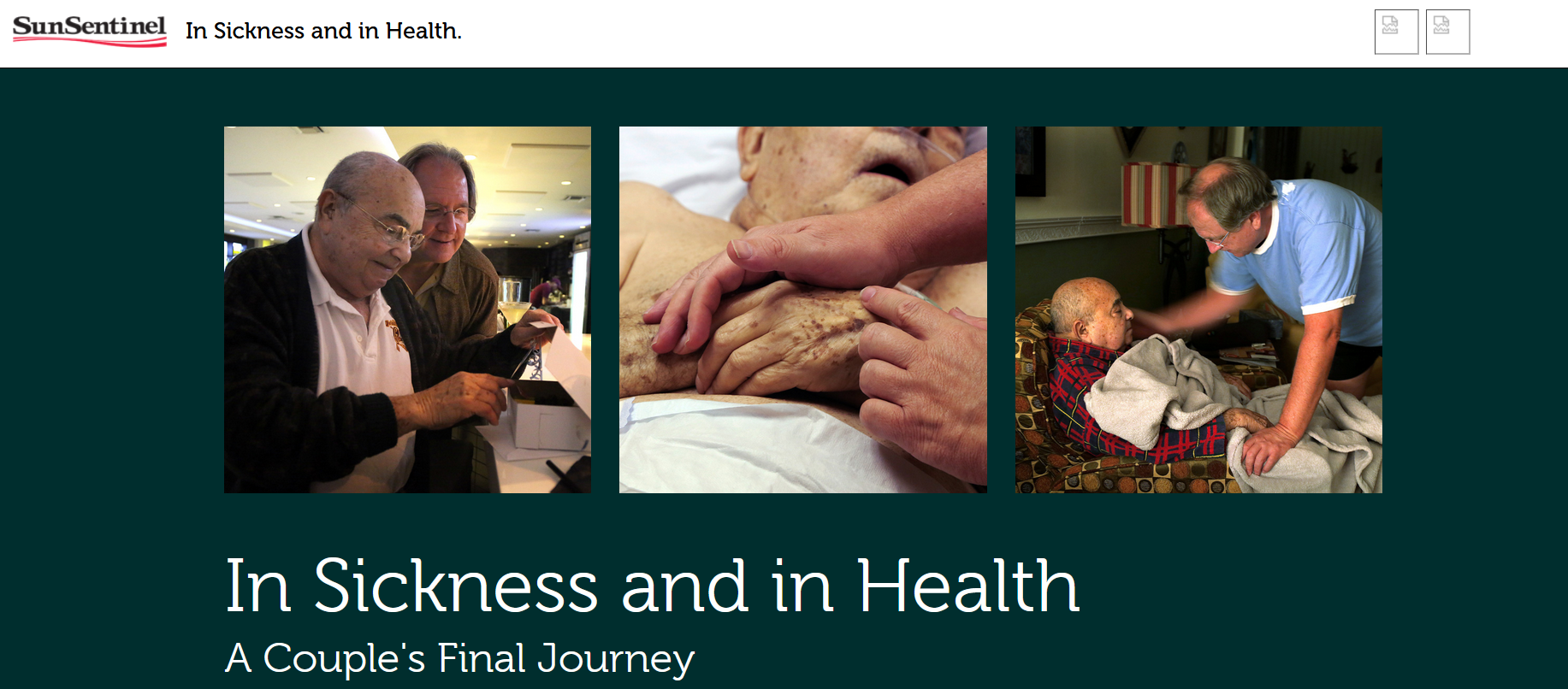
As I think about National Cancer Survivors day, I am reminded about the importance of caregivers sharing our stories with each other.  Writing the blog helped me and Richard cope with the diagnosis.  Our story in the Sun-Sentinel, In Sickness and In Health:  A Couples Final Journey  had a major impact on the importance of  sharing ones story.  I encourage everyone, as they feel comfortable, to share as much of their caregiving story as they possibility can. Sharing ones caregiving story, albeit it cancer, Alzheimer’s, or whatever health calamity you and your caree face, is a good antidote for any insidious  diagnosis, like cancer.

As we age and face different life challenges, we can look back on pictures to help tell the story of what we don’t see right before our eyes.   (2003 thru 2014 – click on the picture to see the year it was taken)

Pictures do tell a thousand stories.  What I did not see in January of 2014, was because I was looking at 2003.  The reality of a cancer diagnosis has a profound affect on everyone.  Sharing ones story has a profound affect too.  It reminds us that we are not alone in our caregiving journey.

I encourage you to share your caregiving story as you feel comfortable because cancer can never take away our love.  You see…”We Might Have Cancer, But Cancer Never Had Us”

Chris MacLellan is the author of “What’s The Deal With Caregiving?” and the host of Healing Ties radio program.

Leave a comment

Filed under Caregiving, The Purple Jacket

Seniors Finding Energy in Self-Driving Cars


We welcome back guest blogger, Maria Alice

Autonomous, or “self-driving,” cars have been making the news rounds for a few years. These computer-controlled vehicles are capable of following a preset course when the driver is impaired or would otherwise be unable to manage the pedals and steering wheel, meaning fewer accidents. These vehicles run on electricity instead of fossil fuels, providing a host of ecological and cost-friendly benefits. These two benefits alone are merely the tip of the iceberg of benefits that self-driving cars can provide.

An automated car means that seniors and others with mobility problems or handicaps can truly share the road with the rest of the driving populace. Elders unable to drive by themselves would simply need to tell the computer where they wanted to the car to take them and then relax. Furthermore, a self-driving car does not require additional, sometimes-costly, mechanical alterations that a conventional handicap-accessible car would require to drive around unsupervised.

The main draw of a self-driving car is that all of the content between point A and point B is handled by someone else. The passenger just needs to know those two points.

When looking into the big names behind this booming industry, Audi, Baidu, BMW, Ford, Google, Mercedes and Tesla, all make appearances. Google offers two different models of self-driving car: one is a “pod” lacking either a steering wheel or pedal and the other is a modified Lexus outfitted with sensors and an on-board computer.

While you may think that this technology is being championed by the elderly, the blind and visually-handicapped will also greatly benefit from the proliferation of self-driving cars. Independence is a big merit for these people and it can do a lot for their self-esteem to know that they don’t need to ask around for a ride or hunt for just enough fare to pay a public bus or taxi. A self-driving car is the perfect means of granting that sort of independence.

The benefits of driverless cars extend beyond just people – the environment gains a huge boon as well. According to Energy Companies Alberta, full integration of electric driverless cars would reduce fossil fuel consumption by nearly 3 billion gallons between relying on electricity, running the vehicle at a sustained speed, and streamlining traffic on busy highways. While electrical self-driving cars would not eliminate fossil fuel usage entirely, the technology could eventually be reworked to handle other industries that involve automotive devices, like the shipping industry.

While all of this information may sound wonderful, the reality is mired in legal quicksand. One speed bump on the road to automotive modernization and the disabled comes from the legal requirements for operating a vehicle. Most states and federal districts have laws on the books which dictate that a driver must be in full control of the vehicle at all times. This means that while driverless cars can be put into the marketplace, a designated driver must still remain within the vehicle as long as it is on the road.

Do we think self-driving cars are a worthy endeavor? Does the idea of giving your parents the freedoms they used to enjoy appeal to you, especially when several major automotive and technology industries are looking into them? Would you rest better not having to include time spent driving them around into your schedule? Do you care about renewable energy and the future of the planet’s health? The short answer to these questions is “yes.” All research points to driverless cars becoming common enough that the gas-guzzling auto will be a relic of the past and will greatly loosen our reliance upon technology that requires fossil fuels to operate.

Maria Alice  is a freelance writer currently living in Chicago. She has a Bachelor of Arts degree in English from the University of Illinois at Chicago with a minor in Communication. She blogs about environmentally friendly tips, technological advancements, and healthy active lifestyles.

Leave a comment

Filed under Caregiving, The Purple Jacket

Dementia Patients at Home: Care Taker’s Guide


The Purple Jacket welcomes back guest blogger Andrea Bell 

Dementia Patients at Home: Care Taker’s Guide

According to the behaviorist perspective, the environment plays a key role in how people behave. The impact comes from the people as well the type of house or even inanimate objects that are placed there. Dementia is not a disease in which a patient can admit himself into a hospital and receive proper treatment. He has to live with it for the rest of his/her life. Since they cannot control the progression of the disease, what they can control is to choose the way they want to spend their remaining years. Home décor can have a significant impact on dementia patients who are receiving care at home. It is important to understand that their life has or is beginning to change drastically, so a change in surroundings to help them adapt better is necessary. Here are some absolutely easy home décor ideas especially for people with Dementia:

  1. Bedding and comfort

Every patient (Dementia or not) needs comfort. Bedding, chairs and sofas should all be soft and cozy enough for the patient to stay in. Discomfort can stress the patient very easily which can increase the adverse effects of the disease. Comfort is also provided through emotional support of the care taker, it is necessary to educate yourself about Dementia patients before taking care of them. Their mattresses should have a plastic covering as well as be fire retardant.

Here are some pages to get you started: How to properly deal with Dementia; Dementia nursing and caring tips.

  1. When Nature calls

Most patients with mild cognitive impairment or even normal physical weaknesses tend to wet their beds. It is absolutely essential to stay absolutely calm as it is already a pretty shameful moment for them. To avoid this, adult diapers and catheters are necessary. Other than this, easy to use bathroom fixtures and fittings are something that can provide the patients and their care takers both, some ease. Also, there are several kinds of bath chairs with all proper washing functions available which can be placed in the bathroom. Get them here.

  1. Reminders and forgetfulness

Dementia is probably the second name for forgetfulness. It can make the patient feel useless, as they at some point are not able to remember important pieces of information, or even the insignificant things like names of different foods or what day it is today. So to help them remember the house should be ‘reminder friendly’ in ways that the patient is instantly reminded of basic things. Sticky Notes always come in handy, even for everyday life. Post them everywhere, especially near the bedside or work areas with whatever information that you choose to remind them.

Large reminder boards can be placed on the wall, or the fridge, which can keep track of things like what time do they have to take their medicine, or how many times or pills do they have to take etc. If it is someone’s special day, like a birthday or a wedding anniversary, it can be easily posted on the reminder board in bold letters, which can allow the patient to be reminded of it every time they look at it or walk by it. You can easily by them from this store.

Bold analogue wall clocks can also be a good way for the patients to keep track of time. Large clocks with bold calendars are also available especially for dementia patients. Get them here.

  1. Way finding and wandering

A smart way to stop the patient from wandering is to plant or paste arrows inside the house, or in the backyard to allow the patient to recognize where he has to go. As soon as he begins to wander, the arrows will prompt him with the path that needs to be followed.

  1. Color selection for the eyes

With Dementia in old age, many patients may develop blindness or cataract eventually leading lives with blurry vision. Usage of bright and bold colors in things that need to be highlighted such as their pill boxes or their food containers can help them locate and even remember it easily. On the other hand, for areas such as those meant for sleeping and relaxing, the colors should be light and pastel in order to provide a soothing effect for the patient. These bold and soothing colors can be integrated into walls, curtains, bed sheets as well as the carpets on the floor.

  1. Organization to reduce confusion

Old age can cause a lot of confusion for the patient, especially if it is accompanied by Dementia. To reduce daily life confusion as much as possible, you can color coordinate their wardrobes, or pre pick out their clothes that they have to wear daily. Arrange their personal belongings or toiletries in a way that they are clear and visible right in front.

Andrea Bell is  freelance writer by day and sports fan by night.  Andrea writes about tech education and health related issues (but not at the same time). Live simply, give generously, watch football and a technology lover. Find Andrea  on twitter @IM_AndreaBell.

(All content and links submitted in this post are written and submitted by Andrea Bell.)


1 Comment

Filed under Caregiving, The Purple Jacket

Graduate: A Thesis Complete


An investment in knowledge pays the best interest. Benjamin Franklin

The road to Spokane has come to a happy ending with the completion and acceptance of my thesis entitled… Spiral of Silence:  Caregiving, Stress and its Impact in the Workplace.   

Originally proposed by German political scientist Elisabeth Noelle-Neumann in 1974, Spiral of Silence is the term meant to refer to the tendency of people to remain silent when they feel that their views are in opposition to the majority view on a subject.  My theory suggested that working family caregivers, fearful of losing their job, do not self-identify at work because they feel that they are in the minority.  I am happy to report that 75% of the respondents who indicated that they did self-identify at work found some form of relief.  However, 25% of the respondents who did not self-identify at work as a family caregiver, were fearful of losing their job or that self-identifying would be of no help to them.  I am very grateful to Denise Brown from Caregiving.com for allowing me to take part in Caregiving.com yearly working family caregiving survey.  Please feel free to reach out to Denise Brown at denise@caregiving.com if you have any further questions about the working family caregiving survey and how you might get a copy.

Of course there is much more to the thesis; we have more work to do to bring awareness to the epidemic of stress that working family caregivers face on a daily basis.

It is difficult to find the words to describe the feeling of earning a Master’s Degree GU_logoin Leadership and Communication from Gonzaga University. I love the Jesuit tradition and the spirit of Gonzaga. Professor Michael Hazel has been terrific throughout the entire process, as have all of the staff at the University. I will always remember Dr. Hazel’s sage advice at the beginning of the thesis in January, when my goals were bigger than the time frame, “The best thesis is a completed thesis.”  Michael Hazel knows his “stuff!” It is a good feeling to have the thesis completed, an even better feeling to now be an alumnus of Gonzaga.  It is nice to know there are life-long friends in Spokane, WA.

11410888-smooth-road-ahead-good-times-recovery-yellow-street-sign-1is84y6I am getting ready to embark on a new road, (one that is not virtual as was my road to Spokane); I look ahead with anticipation and excitement because I am creating a life to love after caregiving ends through writing, radio, travel and advocacy.

Leave your limiting self-doubts behind and go and grab the life you have always dreamed.

That is my new road to follow!

Chris MacLellan is the author of “What’s The Deal with Caregiving” and the executive producer and host of “Healing Ties” radio show  and a alumni of Gonzaga University!


4 Comments

Filed under Caregiving, The Purple Jacket

Confessions Of A St. Louis Blues Fan


If it doesn’t matter who wins or loses, then why do they keep score? Vince Lombardi

Last Monday, I had to take a mental health day from watching Blues hockey.  Maybe I can blame Steve Yzermann , or Kirk McLean and yes…I know I can blame Holy Jumpin’ Roman Turak.  And of course, Mike Keenan is always there to blame!    I’m sure that my mental health day had nothing to do with the last four Springs of Blues hockey.  Sooner or later we’ll play a game in May?

I was there the night when #16 scored that big goal against the Leafs to win a 7th game…oh, wait a minute, that #16 was Kevin LaValle.

I was there for the Monday Night Miracle; there was nothing like seeing a game in the old Arena.

It started way back in 1967, I was 10 years old.  Our seats were section 129, Row G, Seats 4,5,6,7.   My father, being from Charlottetown Prince Edward Island, Canada subscribed to season seats either in the first of second year of the team.  Men dressed in sport coats and ties; Women wore the best apparel.   Cigarette smoke floated to the top of the rafters.  We sang “When The Blues Go Marchin’ In!” Goodness… Where has the time gone?

I remember when Emile Francis put the check back in the Checkerdome.  But it always remained the Arena.  “What A barn burner” Gus Kyle would say.

I remember where I was when Bob Gassoff was tragically killed in a motorcycle accident.  Then I had the pleasure of meeting Bob Gassoff, Jr at Washington University a few years ago.  What a classy person he is!

Brent Seabrook hitting both goal posts…darn the luck!  I remember when Craig Conroy hit both post in overtime against the Red Wings only to watch Brendan Shanahan come down on the next shift and score to end the game.   Yes, that Brendan Shanahan for the RED WINGS.  (By the way, I’m still mad at Judge Huston for sending Scott Stevens to New Jersey!  That was just a couple of years ago, right?!)

From Berenson to Unger; Federko to Sutter; Hull and Oats.  The Plager brothers; McInnis, Pronger, Cujo, and Liut.  There is just something about being a Blues (and Hockey) fan that is different from anything else in sports.   The passion, the speed; the feeling that you know the players first hand.

Those trades we will never forget…”Slash and Spear” twinning up in the Bluenote while Rod Brind’Amour wins a cup in Carolina!.  How many former Blues players have achieved this great accomplishment?  Maybe I don’t want to know.  I’m sure the late, great Ron Caron has some “meat on the burner.”  Those were the days!

The old Arena is long gone and now Kiel, oops, Scotttrade Center is almost 22 years old. I’ve move on to South Florida, but my St. Louis roots still run deep.    I read JR, Tom Timmerman and the new guys at the Post-Dispatch from afar, wondering what ever happened to Dave Lueking, George Csolak,  and Gary Mueller (did I get those names right? I just finished a thesis and don’t feel much up to more research at the moment!)   Of course Gordo and Dan O’Neal are the mainstays, always good reads, too.  I’m sure Broeg and Burns would be proud.

Yes, I had to take a mental health day from Blues hockey on Monday, but with internet radio and the marvels of social media, I could appease my curiosity without the effects of my heart beating out of my body.  Of course a trip to Rita’s in West Palm Beach with my friend Sam helped immensely.  How many people have nephews in their 40’s living Mississippi and Louisiana who kept sending text messages all night with updates.  I remember their first game in the old Arena against the Vancouver Canucks.  Yes…Mississippi and Louisiana have Blues fans too!

I’ll doubt I will need another mental health day from watching Blues hockey for awhile.  But who knows, we are St. Louis Blues fans!  Game time tonight is 8:00 pm EST, I will be glued to the T.V. set again.

Now that I am pushing 60, I know the best is yet to come when JR gets to write a column in the Post-Dispatch this June (well, any June will due!) with the headline:  “Blues Get Four Months Off For Winning The Stanley Cup!”

Chris MacLellan is the host of “Healing Ties” Radio and the author of “What’s The Deal With Caregiving” and a life long avid hockey fan of The St. Louis Blues 

wpid-wp-1448113432219.jpegwpid-wp-1448112894007.jpeg


Leave a comment

Filed under Caregiving, The Purple Jacket

Home Safety Tips for Seniors


We welcome back one of our favorite guest bloggers, Maria Alice, to The Purple Jacket!

We all value our independence and autonomy, both of which are threatened as a person gets older. It’s always better for an elderly person to continue to live in their own home, in familiar surroundings, where they are comfortable. For the majority of the elderly, this arrangement is possible with the right support. In today’s world, safety and home monitoring are easier than ever before.

Home Security

One of the best ways to keep your elderly loved one safe is to have a home security system installed. You can find more information and great resources about different kinds of systems here. The benefit is two-fold: this gives your elderly family member a way to signal if there is a medical emergency, and it also provides protection from outside threats. It’s not pleasant to consider that elderly people living alone might be targets of crime, but unfortunately criminals prey on those least able to defend themselves.

Safety in the Bathroom

The bathroom can be a hazard for older people, whose vision and balance will most likely not be as good as it once was. Slipping in the tub and falling is a common source of injury in the elderly and can have tragic results, especially for those who live alone. According to the Centers for Disease Control and Prevention, one out of every five falls among the elderly leads to broken bones or a head injury. Steps can be taken to minimize risk, such as installing a step-in shower or adding a slip-proof surface to the bottom of the tub. Handrails can also be a major help to senior citizens and should be installed next to the toilet and in the shower.

Lighting and Clutter

Memory and mental function are often impaired in older people, especially those in the early stages of dementia. Sufficient lighting can make a big difference in preventing accidents, as can keeping the home clear of obstacles. The old saying, “a place for everything and everything in its place” was never more appropriate than when describing the kind of environment an elderly person needs. As memory fades, it’s more important than ever for everyday necessities to be within reach and in a familiar place.

Home Hazards

Anything that poses a threat to the safety of your loved one should be put away or safety-proofed. Sharp knives may need to be removed from the kitchen. Hazardous corners should be covered with plastic bumpers. Make sure that there is a clear path to follow from one room to another throughout the house, since the risk of falling increases with age.

Carbon Monoxide and Fire Alarms

Besides a security system, carbon monoxide and fire alarms are two other ways that modern technology can help keep your elderly parent or loved one safe. Because memory in seniors can decrease, there is always the possibility they may turn on an appliance and then forget about it. It is also difficult to determine that there is carbon monoxide in your home without an alarm so it is important to have one installed and checked regularly.

Road Map to Independence

Taking these steps will increase the likelihood of an elderly individual living a safe and happy life in their own home. A security system will provide health and safety monitoring, and modifications to the bathroom can have a great impact on an elderly person’s mobility and independence.

Securing the environment from hazards by providing plenty of lighting and eliminating clutter are first steps toward creating a safe home. And of course, every home should have carbon monoxide and fire alarms to protect the people inside. With these steps, you can provide your elderly loved one with the independence and satisfaction that comes from continuing to live in their own home.

Maria Alice is a freelance writer currently living in Chicago. She has a Bachelor of Arts degree in English from the University of Illinois at Chicago with a minor in Communication. She blogs about environmentally friendly tips, technological advancements, and healthy active lifestyles.

2 Comments

Filed under Caregiving, The Purple Jacket