Tag Archives: Health

Amazement!


Photo Credit: Pinterest

As we continue to move forward with his aftercare, there is amazement on every side of the aisle. Our last report from the primary care doctor was terrific. She, like everyone else involved in his care, is utterly amazed at the progress that ‘The Little One’ has made since this ordeal started almost a year ago. I have been reluctant to blog lately, because quite frankly, I am amazed (and quite busy) too.

When ‘The Little One’ was diagnosed with cancer in late July of 2011, we started six weeks’ worth of treatments almost immediately. The outcome looked bleak back then, and in fact the doctors gave us little hope for the future when the diagnosis came in. ‘Three maybe four months” said the oncologist back in September of 2011.

It was at that time I made the conscious decision to withhold that information from ‘The Little One’ while telling the doctor ‘let’s wait and see how he responds to treatments.’ I never shared that conversation with ‘The Little One’ until after our last appointment with his primary care doctor just a few weeks ago. (If we are doing the math, that last appointment was in June; I was told in August of 2011 that he had 3 to 4 months. We are almost to a year since the first treatments….) Of course, I consulted with the oncologist on the decision not to share this information with ‘The Little One’ , and he agreed. “Let see how the treatments go and let him live his life to the fullest!” He has exceeded all expectations, and now his doctors want to do a case study on him.

Photo Credit: Pinterest

To withhold this information is a difficult judgment call that caregivers, spouses, doctors have to make on a daily basis. I made this decision based on one simple fact. ‘The Little One’ knew that he had cancer, and he knew that it was serious; I also knew that he was going to do anything he possibly could to beat the diagnosis. Why train the mind to think something is going to happen, when we really do not know when is going to happen?

This week, ‘The Little One’ will visit his oncologist for a quarterly check-up. I am confident that the oncologist will be pleased and say again….”Bern, you look great,” which ‘The Little One will reply, “ Yes, I’ve got a new embalmer!” Laughter is the best medicine, even in its most trying times.

What is left of the tumor is dormant and for all intent and purposes, his cancer is in remission. From the first day, we have taken this day by day. What else is there to do? Every case is different. My decision to withhold this information from “The Little One” was not an easy decision to make. After revealing this decision to him, he was glad not to know… even though he did know.

Photo Credit: Pinterest

In a sad, but beautiful twist of fate, ‘The Little One’s lifelong friend Jill has recently been diagnosed with cancer. Like our first report, Jill’s first report has us all concerned. What is beautiful about this is how ‘The Little One’  is able to transfer his experience of this insidious disease to Jill… to encourage her, to console her, to simply be there for her.  This gift of encouragement is one of the best gifts that one can give to a friend.

We send out a big hug and hello to our friend Doug in STL who is going through treatments at this time.  We are thinking of you Doug!

 Remember…We might have cancer…But cancer does not have us.

Photo Credit: The Purple Jacket

As you have noticed, we have taken a break from Blogging on ‘The Purple Jacket’ for the past few weeks.  As I transition into a new job and into a new academic program at Gonzaga University, “The Purple Jacket” will be taking on a new look too.   We will continue to provide you updates on ‘The Little One’ as this blog is really dedicated to him.  Yet in future weeks, we will expand the content of the blog to discuss the effects of Caregiving on the caregiver.   What is often overlooked in Caregiving is the importance of the health of the caregiver.  Personally, I have had to take a long hard look at this issue, and have come to the conclusion  that the best way to deal with this issue is to blog about it.  In essence, there is a real purple jacket.  I just can’t fit into it any longer.   We have to explore the issue of what it means to be a healthy caregiver!

Photo Credit: Caregiving.com

I am BIG fan of Caregiving.com  The community on Caregiving.com is just tremendous and Denise Brown who is the proprietor of this wonderful website, is an expert in the field of Caregiving. You want to be sure to check out Caregiving.com and become a part of the Caregiving family too!  Follow Denise on Twitter @caregiving and on Blog Talk Radio, too!

WE will also be exploring a new communication theory entitled ‘The Theory of Empathic Communication” in an upcoming blog posts, as well as our Phone A Friend program at SunServe Social Services.  We will also be chatting about a great program at the Pride Center in Fort Lauderdale, Coffee & Conversation which takes place every Tuesday morning at 11:00 am in Wilton Manors, Florida.   I will also have some speaking engagements to announce in August and September.  Coming soon,  ‘The Bow-Tie-Guy’ on Blog Talk Radio!  

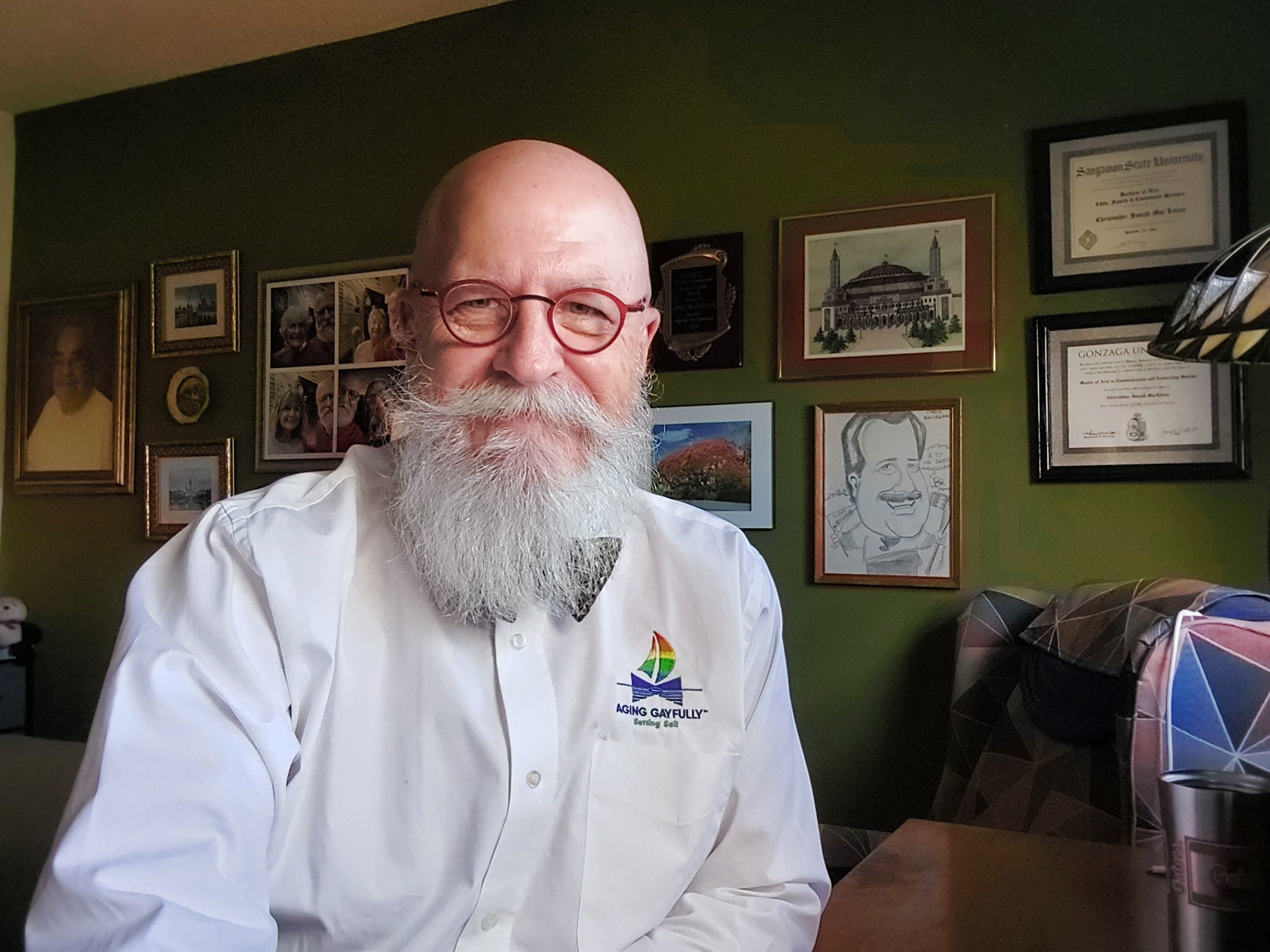
Photo Credit: The Bow-Tie-Guy

6 Comments

Filed under Caregiving, The Purple Jacket

The Bow-Tie-Guy Tip of the Day:


 Live your Life, not your Age! 

Photo Credit: Free Digital Photos

Leave a comment

Filed under Caregiving

The Bow-Tie-Guy Tip of the Day:


Life is meant to be lived in forward, not in reverse.

Photo Credit ‘Free Digital Photo’s’

Leave a comment

Filed under Caregiving

LGBT Caregiving Blog Series


I was privileged to have been had one of my blog post published recently  in the  American Society of Aging; LGBTcaregiving section. ASA’s Aging Issues Network (LAIN) is a great source for LGBT Caregiving and Caregivers.

‘Two Relationships in One’  

To be entrusted with the care of another human being is one of the greatest honors that can be bestowed on you.  It takes on meaning that is beyond approach.  New parents have nine months to prepare for the responsibility. Doctors and nurses undergo years of rigorous training for the work that they do.  But caregivers can find themselves thrust suddenly into roles that they do not choose when called to care for a partner, spouse or loved one after a diagnosis or an accident.

At a moment’s notice you become a caregiver, without any warning or time to think things through. You feel like you have no idea of what you are supposed to do, so you do your best, as you follow your instincts and common sense. You embrace the new reality. You simply care for the one you love.

When you become a caregiver for your life partner, a new and uncharted realm opens up.  Two distinct relationships must now be blended into one. The familiar partner from the past remains and is always present.  But now there is someone different on the scene – someone with a significant illness.

Suddenly, two people sharing a life together will need to face challenges that cannot be left unattended.  A whole set of new and hard-core emotions are likely to intrude on the relationship. Worry, detachment, mortality, anger, fear of abandonment and having to live life alone, to name just a few, begin to intertwine with the idiosyncrasies of your personal dynamics. They can lurk in a caregiver’s mind when faced with a life-and-relationship-altering illness in your partner.

Care giving is an intense experience that asks you to surrender yourself for the needs of someone else.   Often times you have to give up the things you love in order to care for the one you love.  Even though it may feel like a hardship, you make the choice because you know that it is what love and commitment is all about.  Yet it is not that simple, because care giving can be an emotional, physical, and interpersonal roller coaster that is both tremendously rewarding and frustrating. These emotions can surely test even the best communication and trust in a relationship.  The common denominator in the blending of these two relationships is communication.

Communication is a funny thing; just like relationships.  It is funny how the two go hand in hand.  Successful relationships are built on strong communication and trust.    It is through honest communication that the true essence of a partnership is revealed.  This does not change when you add the role of caregiver to the mix.  Communication has to be the focal point for conveying the wants and needs of the one who is ill, and this must be accomplished without losing the identity of either the partnership or the caregiver.  The term “delicate balance” takes on a whole new meaning.

Frequently reviewing and maintaining clarity in your roles becomes crucial so that your judgment and decision-making skills are based on sound facts instead of raw emotions. How much can the mind and body take when faced with so many changes in such a short period?  I think that really depends on the couple’s ability to safely, clearly, and honestly communicate their wants, needs, and desires as indicated by the partner’s health needs first and the personal relationship second.

While I have no doubt that caring for my partner (who has been diagnosed with esophageal cancer) has strengthened our relationship, it has changed our relationship at times, too.  I have seen someone who was firmly independent become dependent in certain areas of life that have been difficult for him to accept.   Stepping outside one’s comfort zone and asking for assistance with mundane everyday chores adds stress to both parties.  That is undeniable!

Caregivers often become the voice for the one who is ill. As caregivers, we have to be mindful that we are in a supporting role;   caregivers are the advocates, not the “deciders”!  In this supporting role, we must remember that what we want for our loved one may not necessarily be what the loved one wants.  What a slippery slope this becomes when the person you are caring for is your life partner!

As part of an LGBT intergenerational couple, I have, on occasion, observed discrimination in our health care system. Here again, personal political preferences may need to be deferred in favor of pragmatism because I am in the role of caregiver.  Successfully addressing and focusing solely on the needs of my partner is paramount.  There will be plenty of time to step up and do what is politically right once I have insured his proper care.

Life’s journeys are not often driven on smooth roads, but we can always hope for a gentle wind at our backs.  That gentle wind is always fortified by love, trust, and commitment.  Come to think about it, aren’t all relationships manifested in this way?

We might have cancer, but cancer does not have us!” 

Below are links to other LGBT Caregiving articles which are worth your read.  I am honored to be a small part of this wonderful group.  I encourage you to bookmark American Society on Aging, especially their LGBT Caregiving Blog Series.  (The ASA logo above will take you to the ASA website)

Finding Pride in Caring: LGBT Caregivers Answer the Call from the Community
By Holly Deni

Sharing Care an Energizing Experience
By Nancy Bereano

Transcending Business as Usual
By Paul R. Blom

Complications of Transgender Caregiving
By Julie Ellingson


7 Comments

Filed under Caregiving, The Purple Jacket

American Society on Aging


I am pleased to share with you my article that was published today with the American Society on Aging. There are five wonderful articles, along with an introduction from Holly Deni who helped collaborate this project;  Finding Pride in Caring: LGBT caregivers answer the call from the community  This link will take you to Holly’s introduction where you can see all the wonderful articles written by LGBT care givers. It is an honor to be associated with these fine people! ENJOY

Leave a comment

Filed under Caregiving, The Purple Jacket

Two Relationships in One


Recently I was asked to write an article on LGBT Care giving for American Society on Aging .   While the published date for article has not been determined; I was given permission to post my article on The Purple Jacket today.

This article has been a work in progress and I am quite honored to have been asked to write about something that has so much meaning for me.  For those of you who have been following my blog, and for those of you who know me personally, it is important for me to say that writing this blog has allowed me to find my voice and step out of my comfort zone.     In finding my voice, I have found an issue to champion.

While The Purple Jacket  will continue to provide updates with  our plight with esophagus cancer and our care giving experiences as life partners; moving forward, The Purple Jacket will advocate and focus on Health and Aging issues within the LGBT Senior Community.

Some might say…”We’ll just what are the issues and what makes LGBT Health and Aging issues different?”  Those are the exact questions and answers we will be pursuing  we move forward with The Purple Jacket.  Our readers will be surprised to learn how many LGBT Seniors are alone, who live in fear, who are in poor health and who are too afraid to ask for assistance.

The issues surrounding LGBT seniors and their health are to enormous to go left unattended.    As  someone who is in ‘the trenches’ as a care giver for my partner, I have a keen sense of understanding of what are the differences and why it is important to discuss these issues with the entire community.  The Purple Jacket  will explore and expand on those issues because “it is our hope that lets us withstand problems; it is our beliefs that let us find solutions.”

‘Two Relationships in One’

To be entrusted with the care of another human being is one of the greatest honors that can be bestowed on you.  It takes on meaning that is beyond approach.  New parents have nine months to prepare for the responsibility. Doctors and nurses undergo years of rigorous training for the work that they do.  But caregivers can find themselves thrust suddenly into roles that they do not choose when called to care for a partner, spouse or loved one after a diagnosis or an accident.

At a moment’s notice you become a caregiver, without any warning or time to think things through. You feel like you have no idea of what you are supposed to do, so you do your best, as you follow your instincts and common sense. You embrace the new reality. You simply care for the one you love.

When you become a caregiver for your life partner, a new and uncharted realm opens up.  Two distinct relationships must now be blended into one. The familiar partner from the past remains and is always present.  But now there is someone different on the scene – someone with a significant illness.

Suddenly, two people sharing a life together will need to face challenges that cannot be left unattended.  A whole set of new and hard-core emotions are likely to intrude on the relationship. Worry, detachment, mortality, anger, fear of abandonment and having to live life alone, to name just a few, begin to intertwine with the idiosyncrasies of your personal dynamics. They can lurk in a caregiver’s mind when faced with a life-and-relationship-altering illness in your partner.

Care giving is an intense experience that asks you to surrender yourself for the needs of someone else.   Often times you have to give up the things you love in order to care for the one you love.  Even though it may feel like a hardship, you make the choice because you know that it is what love and commitment is all about.  Yet it is not that simple, because care giving can be an emotional, physical, and interpersonal roller coaster that is both tremendously rewarding and frustrating. These emotions can surely test even the best communication and trust in a relationship.  The common denominator in the blending of these two relationships is communication.

Communication is a funny thing; just like relationships.  It is funny how the two go hand in hand.  Successful relationships are built on strong communication and trust.    It is through honest communication that the true essence of a partnership is reveled.  This does not change when you add the role of caregiver to the mix.  Communication has to be the focal point for conveying the wants and needs of the one who is ill, and this must be accomplished without losing the identity of either the partnership or the caregiver.  The term “delicate balance” takes on a whole new meaning.

Frequently reviewing and maintaining clarity in your roles becomes crucial so that your judgment and decision-making skills are based on sound facts instead of raw emotions. How much can the mind and body take when faced with so many changes in such a short period?  I think that really depends on the couple’s ability to safely, clearly, and honestly communicate their wants, needs, and desires as indicated by the partner’s health needs first and the personal relationship second.

While I have no doubt that caring for my partner (who has been diagnosed with esophageal cancer) has strengthened our relationship, it has changed our relationship at times, too.  I have seen someone who was firmly independent become dependent in certain areas of life that have been difficult for him to accept.   Stepping outside one’s comfort zone and asking for assistance with mundane everyday chores adds stress to both parties.  That is undeniable!

Caregivers often become the voice for the one who is ill. As caregivers, we have to be mindful that we are in a supporting role;   caregivers are the advocates, not the “deciders”!  In this supporting role, we must remember that what we want for our loved one may not necessarily be what the loved one wants.  What a slippery slope this becomes when the person you are caring for is your life partner!

As part of an LGBT intergenerational couple, I have, on occasion, observed discrimination in our health care system. Here again, personal political preferences may need to be deferred in favor of pragmatism because I am in the role of caregiver.  Successfully addressing and focusing solely on the needs of my partner is paramount.  There will be plenty of time to step up and do what is politically right once I have insured his proper care.

Life’s journeys are not often driven on smooth roads, but we can always hope for a gentle wind at our backs.  That gentle wind is always fortified by love, trust, and commitment.  Come to think about it, aren’t all relationships manifested in this way?

2 Comments

Filed under Caregiving, The Purple Jacket

Excelling in Independence


As we continue with our transition back to Florida, it is hard to believe that we have already been here a month.  Yet,  after one month, it is easy to see the positive affects that this  transitions has had on ‘The Little One.”  It really comes down to one simple aspect of life…INDEPENDENCE.

One of the main issues that usually surfaces in a care giving role is that of independence versus dependence.  We all strive to keep our independence; it’s that physiological edge that makes us want to cry out for more.  Illness in general and cancer in particular, often lead to dependence.  Dependence can heighten the illness in which you are fighting to over come; dependence can in turn lead to depression, which all to often creeps into our physical and mental being.

While we miss our family and friends in St. Louis, ‘The Little One’ has gained quite a bit of his independence back since returning to Florida full-time.  There is a second car to drive, there are long-standing friends and family in the area, there is a house that he shared with his partner Herman for over 30 years, trips to the grocery store and an ocean right down the road; the list goes on and on.  

All to often we tend to forget that it is the simple things in life that mean the most.  When you are a caregiver, often times you have to give up things you love in order to care for the one you love.   It’s not a hardship, it’s not a problem, it is just something you do when you know it is right.

As I sit back and watch the remarkable improvement in his health, we know that life changes on a moments notice. We live in the moment, hoping that our decisions help facilitate good health and prosperity for everyone!  So far, we seem to be on the right track.  When I see ‘The Little One’ pulling out of the garage and off in his little buggy, I think…’how remarkable this truly is given the fact that six months ago he was not even driving a car, a prisoner to our home, dependent in the majority of things that he wanted to do.

Thursday we motor to the Oncologist for our next update; so far all the Doc’s have been pleased.  There is weight gain, there is added strength, there is a mark difference in personality…a personality of independence.

You see, we might have Cancer…But Cancer does not have us!

3 Comments

Filed under Caregiving, The Purple Jacket

The Heart of Caregiving


Cancer came upon us in one full swoop.  Often times, we get into situations that are beyond our control…’things’ just happen, like Cancer.  Care-givers are often thrown into their roles on a moments notice.  Cancer or other debilitating illnesses do not arrive by invitation, they just show up at your door unannounced. When you think about it, no one wants their loved one to be ill, no one wants to see their parent, spouse, child or best friend ill.  Unfortunately, illness is a part of life that we all have to deal with.  At a moments notice you become a care-giver, without any warning, without any preparation, without any idea of what you are supposed to do next.  All of a sudden you are responsible for someones well-being because of their illness.    Care-giving is a tremendous, rewarding  and sometimes a frustrating experience, yet care-giving has meaning to it that is beyond approach.

While I do not often revert  to my theological training, I am reminded of the Corporal Works of Mercy which are, simply stated, the seven practices of charity towards our neighbor…

1. Feed the hungry: 2. Give drink to the thirsty: 3. Clothe the naked: 4. Shelter the homeless: 5. Visit the sick: 6.Visit those in prison: 7. Bury the dead.

I see the Corporal Works of Mercy as a job descriptions for caregivers.  There is an art in accomplishing these task and  and in accomplishing these tasks, one has to have a caring heart.  Care-giving is not a role for the faint of heart, it is not a role suited for everyone.  Just as we all have different talents, skills and life avocations, being a care-giver is no different.  The tryouts are usually on the fly and without much preparation, however care-giving is bound to have a profound effect on all involved in the experience.

One of the most important components of being a care-giver is that you  have a caring heart.  Sound kind of silly doesn’t it?  But it is true!   How many other ‘jobs’ monitor the feelings inside your heart?  Being a care-giver is not a ‘job’ to those who do it, it’s an avocation.    If  you are not truly concerned about the person you are caring for, then it might be a good idea for you  to take a close look at what you are doing for that person. There is a high rate of burn out in care-giving;  care-giving is an  intense experience where you often surrender your self for the needs of someone else.  Finding that happy balance is truly a slippery slope. The art of care-giving always starts with a feeling from inside heart.

2 Comments

Filed under Caregiving, The Purple Jacket

A Word from The Little One


Tonight at dinner we were chatting about our blog as I have been asked to write an article for a national publication on Care-Givers and Care-Giving in April (more to come on that exciting news).  The Little One wanted me to share these words with you this evening…

“Thank you for reading ‘The Purple Jacket” I hope that in reading Chris’ account of my fight with esophagus cancer  that you don’t give up hope, share in the joy and comfort that you can reap from this wonderful thing, a dedicated caregiver. My siblings have pass on; not only is he my caregiver, he is my partner I would be all alone with out his dedication and love.  Even though cancer has struck me, for the second time, I find joy and compassion being with my partner and caregiver.  Go through life with a strong will, even at those darkest times, there is a light at the end of the tunnel.   Bernard Richard Schiffer 2.5.2012.

10 Comments

Filed under Caregiving, The Purple Jacket

‘The Extreme Patient’


While ‘The Little One’ continues to show marked improvement while recovering from the trauma of chemotherapy and radiation, we move on to another calamity called sciatica. Anyone who has had back pain knows how debilitating it can be, yet to alleviate the pain we must be open to new modes of treatment.

On Wednesday we motored to InMotion Health and Wellness for a visit with Dr. Greg Neff to see if Chiropractic help was in order for his current ailment.  The ‘Extreme Patient’ as we see in this photo opportunity for his building fan club,  (yes KJ, the only thing missing is the Tiara!) decided to ride the wave and try out this new treatment.   Of course there was the debate…”This is not going to work”…’Why are we wasting our time”… etc, etc, etc.  While I try not to roll my eyes (at least noticeably  to others), we just continue on with our friendly banter because that is the way we communicate.

Communication is a funny thing; just like relationships.  It’s funny how the two go hand in hand.  Relationships are built on strong communication and trust.    Yet in communicating his apprehension to Chiropractic care, I knew that this was simply a way for him to let off some frustration.    Sometimes, you just have to let go!

As caregivers, we have to be mindful that while we are there in a supporting role, it’s not our body that  is going through the treatments.   How much can the mind and body take in such a short period of time?  I think that really depends on the person and their ability to communicate their wants, needs and desires.  And in the supporting role, the caregiver has to be mindful that what you might want for your loved one, may not be what they want; what a slippery slope!

It is through honest communication,  built on trust and love that truly reveals the essence of a relationship.  We’re glad that we have (and share) this trust and love as we continue on this journey to better health and happiness.


5 Comments

Filed under Caregiving, The Purple Jacket